

Most plumbing problems do not begin with water pouring through the ceiling while somebody runs around looking for a bucket.
They usually start quietly.
A faint trickling noise from the toilet, a stop tap that has not moved in ten years or a water bill that seems slightly higher than expected can all be early warnings. Catching these problems quickly could mean paying for a straightforward repair rather than replacing flooring, repairing plasterwork or dealing with a substantial water bill.
Here are five plumbing facts every homeowner should know, including a few that could potentially save you hundreds, or even thousands, of pounds.
1. Your toilet could be leaking without leaving a puddle
When people imagine a leaking toilet, they often picture water gathering around its base. However, one of the most common toilet leaks happens inside the toilet itself.
Water can continuously escape from the cistern into the toilet bowl. Because it flows directly into the pan, there may be no damp floor, obvious dripping or dramatic sign that something is wrong.
The only clues might be:
- A faint trickling sound
- Ripples at the back of the toilet bowl
- The cistern refilling when nobody has flushed
- An unexplained increase in a metered water bill
- Limescale marks running down the inside of the bowl
WaterSafe reports that a leaking toilet can waste up to 400 litres of clean water every day and may add around £300 a year to the water bill of a metered household. More information is available at https://www.watersafe.org.uk/advice/common_plumbing_questions1/leaks/how_can_i_tell_if_i_have_a_leaky_loo/.
Try the tissue test
Dry the back of the toilet bowl and place a piece of toilet tissue against it. Leave the toilet unused for around 30 minutes. If the tissue becomes wet or begins to break apart, water may be leaking from the cistern into the pan.
The cause could be something relatively small, such as a worn seal, incorrectly adjusted fill valve or faulty flush mechanism. Left alone, however, that small component can quietly waste an enormous amount of water.
A plumber in Ripley, Alfreton or Belper can usually identify the faulty part and advise whether it should be adjusted or replaced.
2. Your water meter can help you uncover hidden leaks
A water meter is not simply there to calculate your bill. It can also act as a basic leak-detection tool.
Some leaks are hidden beneath floors, behind kitchen units, inside walls or along the underground supply pipe between the property boundary and your home. They may continue for weeks before causing an obvious stain, smell or drop in water pressure.
WaterSafe advises that an unusually high bill can indicate a leak in a pipe, appliance or plumbing system. Its guidance can be found at https://www.watersafe.org.uk/advice/common_plumbing_questions1/leaks/how_do_i_know_if_i_have_a_leak_in_or_around_my_home_or_business/.
How to perform a simple meter check
Choose a time when nobody needs to use any water.
- Turn off all taps and water-using appliances.
- Make sure the washing machine and dishwasher are not running.
- Do not flush any toilets.
- Take a photograph of the water meter reading.
- Wait for an hour without using water.
- Check the meter again.
If the reading has changed, there may be water escaping somewhere on the property.
Do not panic if the numbers move, as there may be another explanation. A toilet cistern could be quietly refilling, an appliance might still be drawing water or an outside tap may not be fully closed. However, it is worth investigating rather than waiting for the next bill.
You may be able to claim some money back
Many homeowners do not realise that water companies may provide a leakage allowance when a metered bill has risen because of a leak.
Ofwat explains that water companies are required to set out how they handle leakage from household supply pipes. Once a qualifying leak has been repaired, the customer may be able to receive a credit for some of the water lost. Conditions vary between companies, so the leak should be repaired promptly and evidence of the work should be retained.
Further guidance is available at https://www.ofwat.gov.uk/households/your-water-bill/metering/.
That means calling a plumber in Alfreton, Ripley or Belper quickly could reduce both the repair damage and the final water bill.
3. A blocked drain is not always your financial responsibility
A blocked drain can produce an alarming collection of symptoms: unpleasant smells, slowly draining sinks, gurgling toilets and wastewater rising where it definitely should not.
Before paying privately for major excavation or drain repairs, it is worth establishing who is actually responsible for the affected pipe.
As a general rule, homeowners are responsible for drains within their property boundary that serve only their property. Water and sewerage companies are usually responsible for public sewers, shared sewers and many lateral drains outside the property boundary.
Ofwat explains the division of responsibilities at https://www.ofwat.gov.uk/nonhouseholds/supply-and-standards/public-and-private-sewers/.
Many private sewers and lateral drains were transferred to water companies in October 2011. The government introduced the change partly because homeowners were receiving unexpected bills for pipes they did not realise they owned. Details of the transfer are available at https://www.gov.uk/government/news/transfer-of-private-sewers-will-free-customers-from-unexpected-repair-bills.
How can you tell where the problem is?
A few questions may help:
- Are several neighbouring properties affected?
- Is wastewater rising from a shared inspection chamber?
- Does the blockage appear to be beyond your property boundary?
- Does the affected pipe serve more than one property?
When several homes are experiencing the same problem, the blockage may be within a sewer maintained by the water company.
A plumber Belper homeowners trust can help investigate problems within the property, but the first call for a suspected public or shared sewer problem may need to be your water and sewerage provider. Checking before authorising expensive work could prevent you from paying for something that is not your responsibility.
4. Knowing where your stop tap is could prevent thousands of pounds of damage
The humble stop tap is one of the most important pieces of equipment in your home, yet many people have no idea where theirs is located.
The stop tap controls the incoming mains water supply. In many properties, it can be found beneath the kitchen sink, although it may also be in a utility room, downstairs toilet, cellar or another location close to where the supply pipe enters the building.
If a pipe bursts, turning off the stop tap quickly can dramatically reduce the amount of water escaping into the property.
The Association of British Insurers says escape-of-water damage is one of the most common forms of domestic property claim, with insurers paying approximately £1.8 million every day. Its advice is available at https://www.abi.org.uk/products-and-issues/choosing-the-right-insurance/home-insurance/burst-pipes-and-water-leaks/.
Find it before you need it
Take a few minutes to:
- Locate your internal stop tap
- Make sure everyone in the household knows where it is
- Attach a clear label to it
- Keep the surrounding cupboard accessible
- Check periodically that it can still be operated
WaterSafe recommends finding, checking and labelling the stop tap so that the supply can be shut off quickly during a leak or burst pipe. Its guidance is available at https://www.watersafe.org.uk/news/latest_news/watersafe-warning-stop-tap/.
Turn the stop tap clockwise to close it, but never force it. A seized, leaking or broken valve should be inspected by a qualified plumber rather than attacked with a large spanner and a burst of misplaced confidence.
The difference between shutting off the water in one minute and searching for the valve for twenty minutes could be the difference between mopping a floor and replacing one.
5. Turning temperatures down is not always the safe way to save energy
Reducing heating temperatures can sometimes lower energy use, but it is important to understand which control you are adjusting.
A room thermostat, boiler flow-temperature control and hot-water-cylinder thermostat all perform different jobs.
Where a home has a stored hot-water cylinder, the Energy Saving Trust recommends setting its thermostat between 60°C and 65°C. Its heating-controls guidance is available at https://energysavingtrust.org.uk/advice/thermostats-and-heating-controls/.
The Health and Safety Executive also advises that, where temperature is used to control Legionella risk, hot water should be stored above 60°C. Further information can be found at https://www.hse.gov.uk/healthservices/legionella.htm.
Setting stored water unnecessarily high may increase heat loss and energy use. Setting it too low could allow harmful bacteria to grow.
That means “turn everything down and hope for a cheaper bill” is not the best strategy.
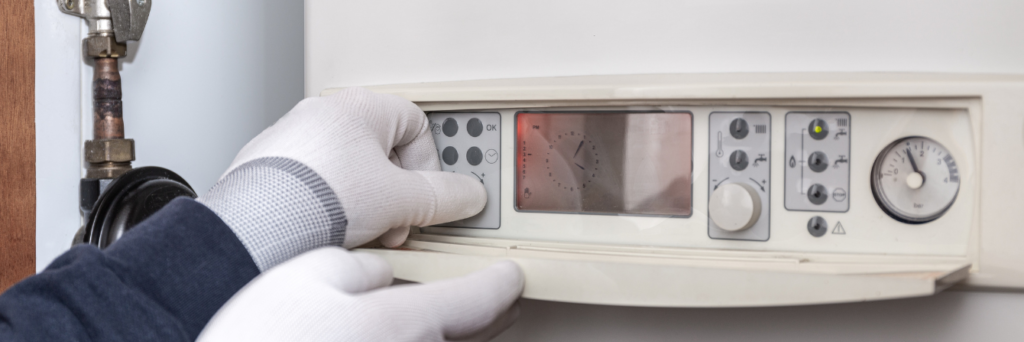
A heating engineer or experienced plumber Ripley, Alfreton or Belper residents can call upon will be able to identify the type of system installed and explain which controls can be adjusted safely.
Combi-boiler households have a different setup because they generally heat mains water as it is required rather than storing it in a cylinder. Advice appropriate for one heating system may therefore be unsuitable for another.
Small checks can prevent large bills
Plumbing problems rarely improve through patience. A toilet that trickles today may waste thousands of litres over the next few weeks. A slightly damp cabinet may become rotten flooring, while a hidden supply-pipe leak could continue increasing a metered bill.
A few simple habits can make an enormous difference:
- Check toilets for silent leaks
- Investigate unexpected increases in water consumption
- Learn which drains are your responsibility
- Find and label your stop tap
- Make sure heating and hot-water controls are set correctly
- Arrange repairs before minor faults cause secondary damage
Need a Local Plumber?
Leeva Plumbing & Heating provides reliable plumbing and heating services across Ripley, Alfreton, Belper and the surrounding areas.
Whether you are looking for a plumber in Ripley to investigate a hidden leak, a plumber in Alfreton to repair a faulty toilet or a plumber in Belper to deal with a troublesome tap, early professional attention could help prevent a far more expensive problem.
For dependable local support, contact Leeva Plumbing & Heating. Your trusted plumber Ripley, plumber Alfreton and plumber Belper homeowners can turn to for practical advice and professional repairs.
 Fully Installed Baxi Boiler