

There are plenty of exciting things to spend money on. Holidays. Meals out. A new TV. A suspiciously expensive barbecue you’ll use four times before October arrives.
Your gas bill is rarely one of them.
Unfortunately, if you’ve got an ageing, inefficient boiler, you could be sending more of your hard-earned money towards heating your home than you really need to. And while a boiler replacement might not provide quite the same immediate thrill as booking a week somewhere sunny, the savings from a modern, efficient boiler can make a surprisingly big difference over time.
In fact, according to the Energy Saving Trust, replacing an old G-rated boiler with a new A-rated boiler and a full set of heating controls could save a household in Great Britain around £420 a year.
That’s £420 that could stay in your bank account rather than disappearing up the flue.
And £420 buys quite a lot of tea.
First Things First: Why Does an Old Boiler Cost More to Run?
Think of an old boiler a little like an elderly car.
It may still get you where you need to go, but it probably uses more fuel doing it, makes slightly concerning noises and occasionally leaves you wondering whether today is the day something expensive happens.
The basic problem is efficiency.
Your boiler takes the energy contained in gas and turns it into heat for your radiators and hot water. The more efficiently it can do that, the less gas it needs to achieve the same result.
Modern condensing boilers are designed to recover heat that older boilers would simply allow to escape through the flue. That means more of the energy you’re paying for actually ends up heating your house.
And when heating and hot water account for more than half of the energy used in a typical home, improving the efficiency of your heating system can have a significant effect on household energy costs.
In other words, concentrating on your boiler makes rather more sense than wandering around switching off the tiny red light on the television.
So, How Much Could an Efficient Boiler Actually Save?
The headline figure from the Energy Saving Trust is worth repeating.
Replacing a G-rated boiler with an A-rated boiler and full heating controls could save around £420 per year in Great Britain.
That works out at approximately:
- £35 per month
- £8 per week
- £1.15 per day
Admittedly, £1.15 appearing in your bank account every morning probably wouldn’t cause you to immediately hand in your notice and retire to Barbados.
But over an entire year, it starts looking much more interesting.
It is important to point out that efficient boiler savings vary from home to home. You won’t automatically save £420 simply by having a shiny new boiler fitted.
Your actual gas bill reduction will depend on things such as the age and efficiency of your current boiler, the size and insulation of your property, your heating habits, your chosen boiler and the controls installed alongside it.
If your existing boiler is already relatively modern and efficient, the difference may be smaller. If it’s an ancient box that has been hanging on the kitchen wall since people were renting VHS tapes, the potential improvement could be considerably more noticeable.
What Does £420 Actually Buy?
Energy savings sound much more exciting when you stop measuring them in kilowatt-hours and start measuring them in things you’d actually like.
So, purely for entertainment purposes, imagine your new boiler managed to deliver that £420 annual saving.
The Tea Option
Let’s generously estimate that a homemade cup of tea costs around 15p once you’ve accounted for the teabag, milk and energy needed to boil the kettle.
£420 would therefore buy approximately:
2,800 cups of tea.
That’s nearly eight cups every single day for a year.
We aren’t suggesting you should drink eight cups of tea a day.
We’re merely pointing out that financially, the boiler has your back.
The Weekend Away Option
Put £140 aside for each mini-break and your £420 saving becomes:
Three £140 weekend-away funds.
Whether £140 gets you a delightful countryside escape or one night in a Travelodge next to a roundabout depends largely on when and where you book.
Still, it’s much more appealing than paying for wasted gas.
The Monthly Treat Option
That £420 also works out at £35 a month.
That could become your takeaway fund, a family day out, cinema trips, a meal somewhere nice or simply £35 that doesn’t have to leave your bank account.
A more efficient boiler isn’t exactly a money-printing machine.
But saving money on something you need to buy anyway — heat — is about as close as your airing cupboard is likely to get.
Why Energy Efficiency Matters Even More When Gas Prices Rise
The less gas your boiler wastes, the less exposed you are to changes in gas prices.
As of July to September 2026, Ofgem’s average gas unit rate for households on capped standard variable tariffs paying by Direct Debit is 7.33p per kWh, with Ofgem reporting that the overall energy price cap rose by 13% for this quarter.
Of course, tariffs and energy prices change regularly.
But the basic maths remains the same:
If your boiler needs less gas to heat your home, you buy less gas.
That’s the real benefit when looking for ways to save energy with your boiler. You aren’t trying to make the house colder or convincing everyone that wearing three jumpers indoors is character-building.
You’re simply getting more useful heat from the fuel you’re already paying for.
A New Boiler Isn’t Working Alone
There’s another important part of the story.
Heating controls.
Modern heating systems allow you far greater control over when and where you’re using energy. A programmer, room thermostat and thermostatic radiator valves can prevent your heating system from merrily burning gas when nobody needs it.
The Energy Saving Trust estimates that installing a programmer, thermostat and thermostatic radiator valves could save around £100 a year in Great Britain.
Thermostatic radiator valves are particularly useful because they allow you to control individual rooms.
Why heat the spare bedroom to tropical temperatures when the only person enjoying it is a suitcase?
Good controls mean you can direct heat where you actually need it.
Signs Your Boiler Might Be Ready for Retirement
Nobody needs to replace a perfectly good boiler simply because a newer model exists.
However, boiler replacement becomes worth considering when an older boiler is becoming increasingly inefficient, unreliable or expensive to maintain.
Potential warning signs include:
- Your energy bills seem to be creeping upwards despite similar usage.
- The boiler requires increasingly frequent repairs.
- Your radiators take longer than they used to to warm up.
- Some rooms struggle to reach a comfortable temperature.
- The boiler makes noises that sound as though something small and angry is trapped inside.
- Replacement parts are becoming difficult or expensive to obtain.
- Your boiler is very old and significantly less efficient than modern alternatives.
If you’re repeatedly spending money keeping an old boiler alive, eventually there comes a point when another repair isn’t necessarily the most economical choice.
Don’t Forget the Less Obvious Savings
Lower gas consumption is the obvious financial benefit, but replacing an unreliable boiler can potentially save money in other ways too.
A modern system may mean fewer unexpected repair bills, while improved heating controls can reduce wasted energy. If your heating system is cleaned, balanced and properly configured during installation, it may also operate more effectively as a whole.
There’s also something to be said for reliability.
Discovering that your boiler has stopped working at 7pm on a freezing January evening tends to make energy efficiency feel considerably less theoretical.
Could a New Boiler Pay for Itself?
A new boiler should really be viewed as a long-term home investment rather than a quick money-making exercise.
The Energy Saving Trust currently puts the typical cost of replacing a G-rated gas boiler with an A-rated boiler and thermostatic radiator valves at around £3,500, although actual installation costs vary significantly depending on the boiler, property and work required.
So you shouldn’t replace a working modern boiler purely because somebody has promised instant riches from lower gas bills.
However, if your existing boiler is nearing the end of its useful life anyway, the potential energy savings become an important part of deciding whether to keep repairing it or invest in something newer and more efficient.
And those savings continue year after year.
Want a Gas Bill Reduction? Start With the Heating System
There are plenty of little energy-saving tips worth doing.
Don’t leave lights on unnecessarily. Don’t boil a completely full kettle when you’re making one cup of tea. Turn appliances off when they aren’t needed.
But don’t ignore the appliance responsible for one of the biggest energy demands in the house.
If your boiler is outdated and inefficient, upgrading it can mean using less gas while keeping your home just as comfortable.
That’s the beauty of genuine efficient boiler savings: you aren’t saving money by sitting in a freezing living room underneath six blankets.
You’re saving it by producing the heat you need more efficiently.
Is It Time to Give Your Old Boiler Its Retirement Card?
If your boiler has been faithfully heating your home for many years but is now becoming expensive, inefficient or unreliable, it could be worth finding out what a modern replacement might offer.
Leeva Plumbing & Heating can assess your existing heating system, discuss suitable boiler options and help you decide whether replacement makes financial and practical sense for your home.
Because while a new boiler might not come with a swimming pool, airport lounge or complimentary breakfast…
Saving hundreds of pounds a year could certainly help pay for them.
And if you don’t fancy the holiday?
There are always those 2,800 cups of tea.
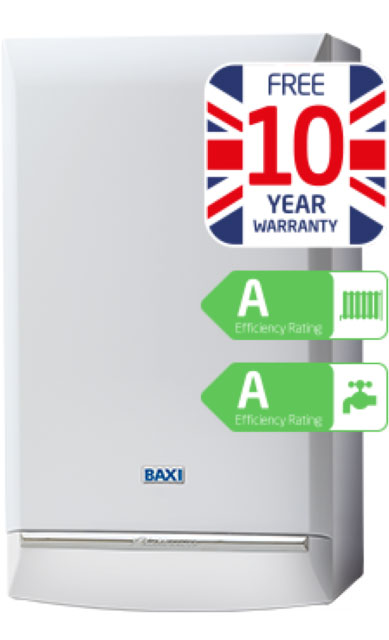 Fully Installed Baxi Boiler